The Fragile Alchemy of Sand and Sea: How Reclamation’s Illusion of Permanence Masks a Battle Against Time
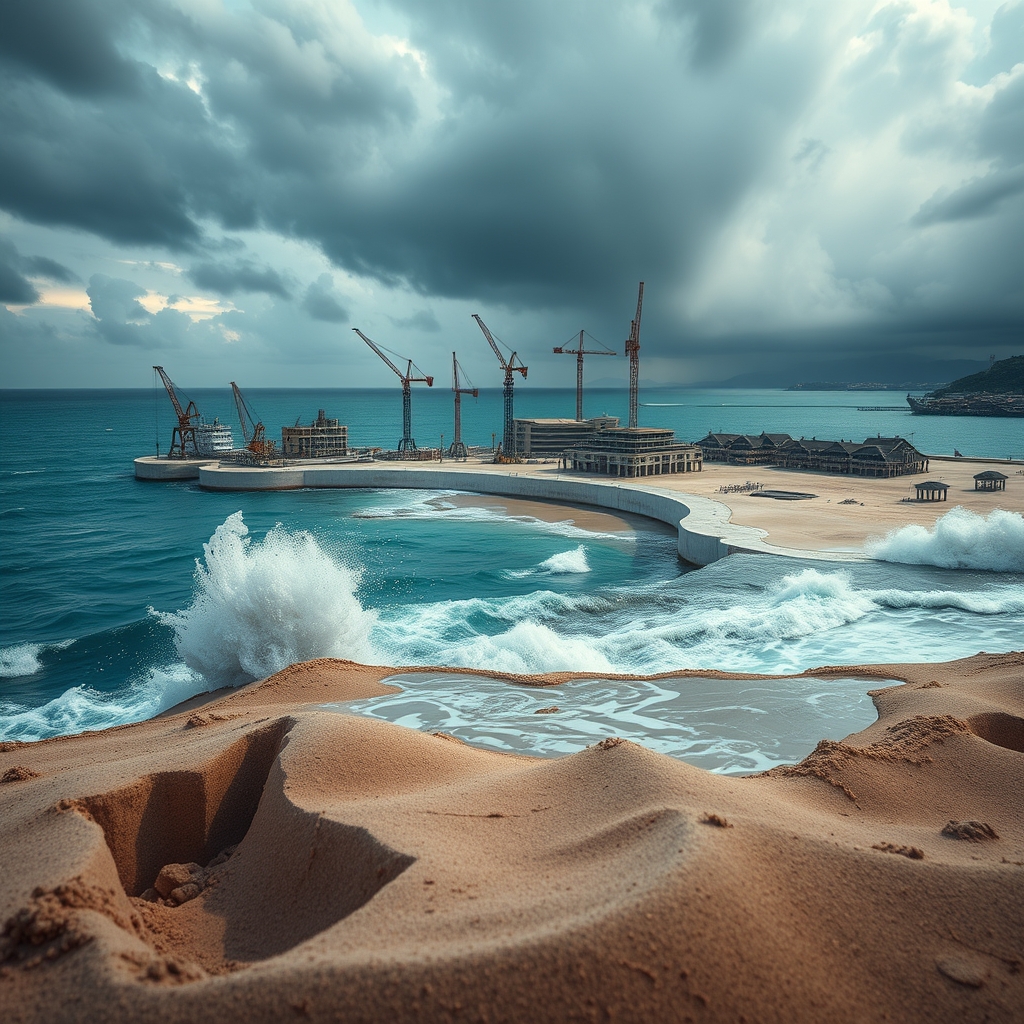
The ocean does not yield its territory willingly. Every square meter of reclaimed land is a negotiation—with tides, with sediment, with the slow, inexorable rise of the sea itself. Yet the narrative spun by developers, governments, and urban planners often frames land reclamation as a triumph of human ingenuity, a seamless expansion of habitable space into the blue frontier. The reality is far more precarious. Beneath the gleaming facades of artificial archipelagos and waterfront megaprojects lies a fragile alchemy of sand, salt, and ambition, where the illusion of permanence is constantly eroded by the very forces it seeks to defy.
The Myth of Static Shorelines
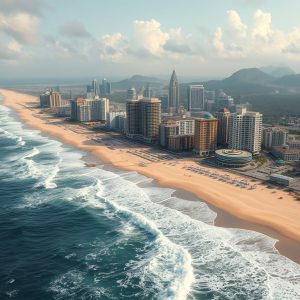
Coastal engineering has long operated under the assumption that shorelines are static, that the boundaries between land and sea can be fixed with enough concrete and steel. This assumption is not just flawed—it is actively dangerous. The Dutch, masters of reclamation, have spent centuries perfecting their dike systems, yet even they now acknowledge that their famed polders are temporary solutions in an era of accelerating sea level rise. The same can be said for Dubai’s Palm Islands, Singapore’s Marina Bay, or China’s sprawling artificial archipelagos in the South China Sea. Each of these projects was designed with a static coastline in mind, but the sea does not respect blueprints.
Recent studies on coastal subsidence reveal a troubling trend: many reclaimed lands are sinking faster than anticipated. In Jakarta, parts of the city’s reclaimed coastline are subsiding at rates of up to 25 centimeters per year, a consequence of groundwater extraction and the sheer weight of urban development. The irony is stark—land reclaimed to escape rising seas is instead accelerating its own inundation. The problem is not just technical but philosophical: reclamation projects treat the ocean as a passive void to be filled, rather than a dynamic system with its own agency.
The Sedimentary Paradox
The foundation of any reclamation project is sediment—dredged, pumped, and compacted into submission. Yet sediment is not an inert material; it is alive with currents, erosion, and the slow creep of geological time. The Palm Jumeirah, for instance, required over 100 million cubic meters of sand, much of it dredged from the Persian Gulf’s seabed. But the Gulf’s currents are relentless, and the island’s crescent-shaped breakwater was designed to mimic natural sediment transport patterns. It was an elegant solution—until it wasn’t. Within years, erosion began to eat away at the island’s edges, forcing costly maintenance dredging to replenish the lost sand. The lesson is clear: reclamation is not a one-time act of creation but an ongoing battle against entropy.
This sedimentary paradox extends beyond individual projects. The global sand trade, driven in large part by reclamation demand, is depleting riverbeds and coastal ecosystems at an unsustainable rate. The UN estimates that sand extraction now exceeds natural replenishment by a factor of two. The very material that makes reclamation possible is becoming scarcer, raising questions about the long-term viability of large-scale land augmentation. If sand is the new oil, then reclamation projects are the gas-guzzling SUVs of urban expansion—consuming resources at an unsustainable rate while promising a future they cannot deliver.
The Illusion of Control in Deep Sea Foundations
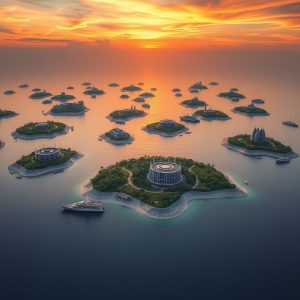
As shallow-water sites become saturated, developers are turning to deeper waters, where the challenges of reclamation multiply. Deep sea foundations require innovative engineering—floating caissons, suction piles, and gravity-based structures that can withstand the immense pressures of the open ocean. The Maldives’ proposed floating city, for example, relies on a modular system of hexagonal platforms anchored to the seabed, designed to rise and fall with the tides. It is a bold vision, but one that assumes a level of control over marine environments that may be illusory.
The deeper the water, the more unpredictable the forces at play. Storm surges, underwater landslides, and even seismic activity can compromise the integrity of deep-sea foundations. The 2011 Tōhoku earthquake in Japan, which triggered a devastating tsunami, also caused liquefaction in reclaimed lands, turning solid ground into a slurry of sand and water. Such events are not anomalies but reminders that the ocean’s depths are far from passive. The deeper we build, the more we expose ourselves to risks that are poorly understood and difficult to mitigate.
The Legal and Ecological Labyrinth
Reclamation does not just reshape coastlines—it redraws legal and ecological boundaries. The concept of submerged land rights, for instance, is a legal minefield. In the United States, the Submerged Lands Act grants states jurisdiction over submerged lands within three nautical miles of their coastlines, but federal law governs the outer continental shelf. This division creates a patchwork of regulations that developers must navigate, often leading to protracted legal battles. The situation is even more complex in international waters, where artificial islands can trigger disputes over sovereignty and maritime borders. China’s construction of military outposts on reclaimed reefs in the South China Sea is a case in point, demonstrating how reclamation can become a tool of geopolitical assertion.
Ecologically, the impacts are equally fraught. Dredging disrupts benthic ecosystems, smothers coral reefs, and alters sediment transport patterns, leading to unintended consequences like increased coastal erosion downcurrent. The construction of Hong Kong’s third runway, for example, required the dredging of 650 million cubic meters of marine mud, much of which was dumped in open waters, creating plumes of sediment that suffocated marine life. Such projects are often justified on economic grounds, but their ecological costs are externalized, borne by future generations and the marine environments that sustain them.
The Blue Economy’s Faustian Bargain
Proponents of reclamation argue that it is essential for the blue economy—a term that encompasses everything from aquaculture to renewable energy to luxury tourism. But the blue economy is not a monolith; it is a collection of competing interests, many of which are fundamentally at odds with sustainability. Luxury island resorts, for instance, promise exclusivity and seclusion, but their construction often involves the destruction of mangroves, seagrass beds, and other coastal ecosystems that act as natural storm barriers. The Maldives, a nation synonymous with overwater bungalows and pristine beaches, is now facing an existential crisis as rising seas threaten to swallow its reclaimed islands whole.
The blue economy’s reliance on reclamation also perpetuates a dangerous myth: that the ocean’s resources are infinite. They are not. The same ecosystems that support fisheries, tourism, and carbon sequestration are being degraded by dredging, pollution, and coastal development. The irony is that the very projects meant to capitalize on the blue economy are undermining its long-term viability. It is a Faustian bargain—short-term gains in exchange for a future where the ocean’s bounty is diminished, and the land we fought so hard to reclaim is once again claimed by the sea.
The allure of reclamation lies in its promise of mastery—over nature, over scarcity, over the very limits of geography. But the ocean is not a canvas to be painted with sand and concrete; it is a dynamic, living system that demands humility. The most successful reclamation projects are not those that seek to dominate the sea, but those that work with it, designing flexible, adaptive infrastructures that can evolve alongside the changing coastline. The Dutch have a word for this: ruimte voor de rivier—room for the river. The same principle applies to the sea. The future of coastal resilience does not lie in rigid, static structures, but in systems that can bend without breaking, that can retreat when necessary, and that acknowledge the ocean’s power rather than pretending it can be tamed. The battle for the coastline is not a war to be won, but a negotiation to be sustained—one that requires us to accept that some lands, no matter how hard we fight for them, were never meant to be ours to keep.