The Unseen Depths: How Deep Sea Foundations Are Redefining the Ethics of Land Reclamation Beyond the Shoreline

The relentless pursuit of urban expansion has driven humanity to the edges of the ocean, where the boundaries between ambition and ecological responsibility blur. As coastal cities exhaust their terrestrial limits, the allure of the sea as a frontier for development grows stronger. Yet, the engineering feats required to transform open water into habitable land demand more than just sand and steel—they require a redefinition of ethical boundaries, particularly when it comes to deep sea foundations. These submerged structures, often overlooked in the grand narratives of land reclamation, are where the true test of sustainability begins.
The Illusion of Solid Ground
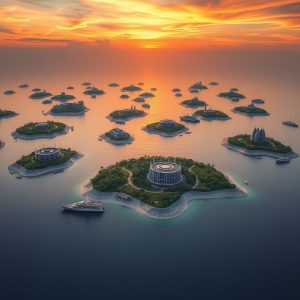
At first glance, man-made islands appear as triumphs of human ingenuity—sleek, self-contained ecosystems rising from the waves, promising luxury, innovation, and economic growth. But beneath the polished surfaces of these developments lies a complex web of deep sea foundations, where the laws of physics and ecology collide. Traditional reclamation methods, which rely on dredging and landfill, are increasingly inadequate for projects that push farther from shore. The deeper the water, the more unstable the seabed, and the greater the need for engineered solutions that can withstand the relentless forces of the ocean.
Deep sea foundations, such as caissons, piles, and gravity-based structures, are designed to anchor these artificial landscapes to the ocean floor. Yet, their installation disrupts marine ecosystems in ways that are only beginning to be understood. The process of driving piles into the seabed generates noise pollution that can disorient marine life, while the displacement of sediment smothers benthic communities. The ethical dilemma is stark: how much ecological disruption is justifiable in the name of progress?
The Engineering Paradox
The shift toward deep sea foundations is not merely a technical evolution but a philosophical one. Coastal engineering has long operated under the assumption that nature can be controlled, that the ocean’s unpredictability can be tamed with enough concrete and steel. Yet, the deeper the foundations go, the more apparent the limitations of this mindset become. The ocean is not a static canvas for human ambition; it is a dynamic, living system that resists domination.
Consider the challenges of constructing foundations in deep water. The pressure at these depths is immense, and the materials used must be both durable and adaptable. Corrosion, biofouling, and the sheer weight of the structures themselves create a constant battle against degradation. Moreover, the environmental impact of sourcing and transporting these materials—often from distant quarries or factories—adds another layer of complexity to the sustainability equation. The carbon footprint of deep sea foundations is rarely accounted for in the glossy brochures of luxury island resorts, yet it is a critical factor in assessing their long-term viability.
The Legal and Ecological Labyrinth
The ethical implications of deep sea foundations extend beyond engineering and into the realm of law and governance. Who owns the seabed? Who is responsible when reclamation projects disrupt marine habitats or alter coastal currents? The United Nations Convention on the Law of the Sea (UNCLOS) provides a framework for submerged land rights, but its application is often ambiguous, particularly in disputed waters. The result is a patchwork of regulations that vary by region, leaving gaps that developers exploit to push boundaries—both literal and ethical.
Ecologically, the consequences of deep sea foundations are equally fraught. The installation of these structures can create artificial reefs, which, while beneficial to some species, often favor invasive or opportunistic organisms over native ones. The disruption of sediment flow can lead to coastal erosion in adjacent areas, undermining the very resilience that reclamation projects aim to enhance. The irony is inescapable: in attempting to create stable land, we may be destabilizing the ecosystems that sustain us.
The Blue Economy’s Ethical Reckoning
The rise of deep sea foundations is symptomatic of a broader shift in the blue economy—a term that encompasses all economic activities related to the ocean. As nations and corporations vie for dominance in this emerging sector, the ethical considerations of land reclamation are often sidelined in favor of short-term gains. The promise of floating real estate, smart marine cities, and artificial archipelagos is intoxicating, but it obscures the reality that these projects are built on borrowed time. The ocean does not yield its territory lightly, and the deeper we venture, the higher the stakes become.
Yet, there are glimmers of hope. Advances in eco-friendly reclamation techniques, such as the use of biodegradable materials and low-impact construction methods, suggest that a more sustainable approach is possible. The challenge lies in scaling these innovations without succumbing to the same hubris that has defined previous eras of coastal development. The deep sea foundations of the future must be designed not just to support human ambition, but to coexist with the ocean’s inherent unpredictability.
The Path Forward: Beyond the Shoreline
The conversation around deep sea foundations is ultimately a conversation about humanity’s relationship with the natural world. It is a reminder that progress cannot be measured solely in square kilometers of reclaimed land or the number of luxury resorts dotting the horizon. True sustainability requires a shift in perspective—one that acknowledges the ocean not as a resource to be exploited, but as a partner in the delicate balance of life on Earth. The foundations we lay today will determine whether future generations inherit a coastline of resilience or a landscape of regret. The choice is ours, but the clock is ticking, and the tide waits for no one.