The Silent Revolution: How Smart Marine Cities Are Rewriting the Rules of Land Augmentation
The ocean has long been humanity’s final frontier—a vast, untamed expanse that beckons with the promise of expansion, wealth, and innovation. Yet, as coastal cities strain under the weight of urbanization and climate change tightens its grip, the sea is no longer just a boundary to be crossed but a canvas to be reshaped. The rise of smart marine cities and artificial archipelagos marks a silent revolution in land augmentation, one that blends cutting-edge engineering with the cold calculus of economic ambition. But beneath the glossy renderings of floating utopias lies a fundamental question: Are we building the future or merely delaying the reckoning with the limits of our own ingenuity?
The Illusion of Infinite Space
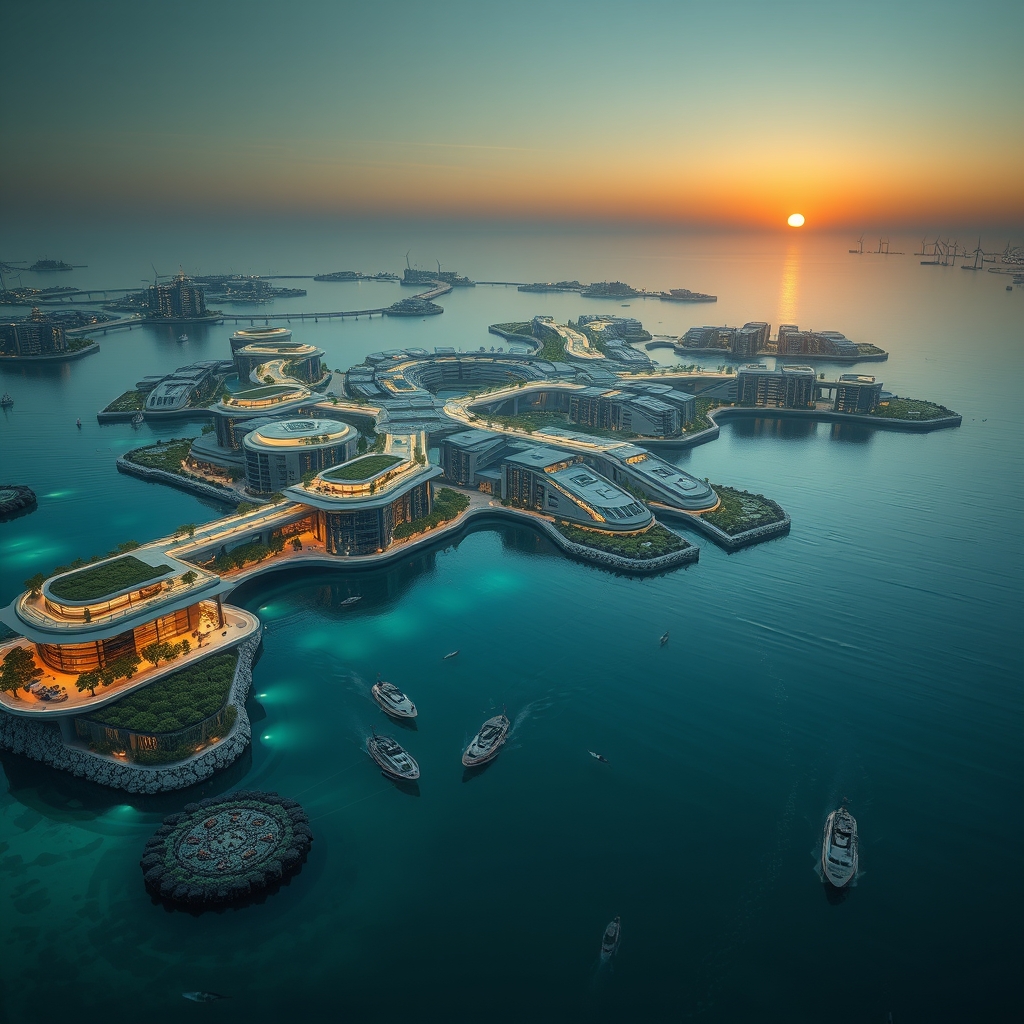
For decades, land reclamation was a brute-force endeavor—dredging, dumping, and compacting sediment until terra firma emerged from the waves. The results were often crude, ecologically disruptive, and vulnerable to erosion. Today, however, the game has changed. Smart marine cities leverage advanced materials, real-time environmental monitoring, and modular construction to create land that is not just stable but adaptive. The Palm Jumeirah in Dubai, Eko Atlantic in Nigeria, and the proposed Oceanix City in South Korea are not mere vanity projects; they are proof-of-concept laboratories for a new era of urban expansion.
Yet, the allure of infinite space is deceptive. Every square meter of reclaimed land comes at a cost—displaced marine ecosystems, altered sediment flows, and the ever-present threat of subsidence. The Netherlands, a pioneer in land augmentation, has spent centuries perfecting its dike-and-polder system, only to face the sobering reality that no engineering feat is permanent in the face of rising seas. Smart marine cities may be more sophisticated, but they are not immune to the same fundamental constraints: the ocean does not yield; it endures.
The Blue Economy’s Double-Edged Sword
The rhetoric surrounding smart marine cities is steeped in sustainability. Proponents argue that floating real estate, renewable energy integration, and closed-loop water systems can create self-sustaining urban ecosystems. The blue economy—an economic framework that seeks to harness marine resources without depleting them—is often invoked as the guiding principle. But the reality is far messier. Luxury island resorts and high-end residential developments dominate the landscape, catering to the ultra-wealthy while local communities bear the brunt of ecological disruption.
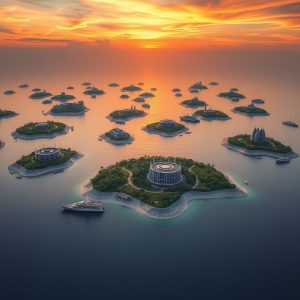
Consider the Maldives, where artificial islands like Hulhumalé have been hailed as a lifeline for a nation threatened by sea-level rise. Yet, these projects are often financed by foreign investors and designed to attract tourism dollars, not to serve the needs of the Maldivian people. The blue economy, in this context, becomes a euphemism for exploitation—a way to monetize the ocean’s resources while externalizing the environmental costs. Smart marine cities may be technologically advanced, but they are not inherently equitable.
The Legal and Ecological Labyrinth
Land augmentation does not occur in a vacuum. It exists at the intersection of maritime law, environmental regulation, and geopolitical maneuvering. The United Nations Convention on the Law of the Sea (UNCLOS) provides a framework for submerged land rights, but enforcement is uneven, and disputes over artificial islands have already flared in the South China Sea. Meanwhile, the ecological consequences of reclamation are often overlooked until it is too late. Coral reefs smothered by sediment, fish populations decimated by dredging, and coastal erosion accelerated by altered wave patterns—these are not hypothetical risks but documented outcomes.
Smart marine cities attempt to mitigate these issues through design. Floating foundations, for example, reduce the need for dredging, while artificial reefs can be integrated into breakwaters to support marine life. But these solutions are not universally applied. Too often, sustainability is treated as an optional feature rather than a non-negotiable requirement. The result is a patchwork of projects that vary wildly in their environmental impact, with some pushing the boundaries of eco-friendly reclamation while others repeat the mistakes of the past.
The Adaptive Imperative
The most pressing challenge for smart marine cities is not technological but philosophical. Can we design land augmentation projects that are truly resilient, or are we merely delaying the inevitable? The answer lies in adaptability. Static structures—whether polders or man-made islands—are inherently vulnerable to a dynamic ocean. The future of coastal resilience may lie in hybrid systems: floating neighborhoods that rise and fall with the tides, modular breakwaters that can be reconfigured in response to storm surges, and artificial wetlands that absorb excess water while supporting biodiversity.
Singapore’s Marina Bay Sands and the Netherlands’ Sand Motor project offer glimpses of this adaptive approach. The former combines urban development with flood control, while the latter uses natural sediment deposition to reinforce coastlines. These projects demonstrate that smart marine cities must be more than just technologically advanced; they must be ecologically attuned. The ocean is not a passive resource to be exploited but a living system with which we must coexist.
The Human Factor
At its core, the debate over smart marine cities is a debate about human ambition. We are a species that has always sought to push boundaries, to bend nature to our will. But the ocean is a reminder of our limits. It is vast, powerful, and indifferent to our aspirations. The most successful land augmentation projects will be those that acknowledge this reality—not by attempting to conquer the sea, but by learning to live within its rhythms.
This does not mean abandoning innovation. On the contrary, it demands a more nuanced approach—one that balances economic opportunity with ecological stewardship, and technological prowess with humility. The silent revolution of smart marine cities is not just about building land; it is about redefining our relationship with the ocean. The question is whether we will rise to the challenge or be swept away by the tide of our own hubris.