The Hydrological Illusion: How Smart Marine Cities Are Betting on Water Without Understanding Its Rules
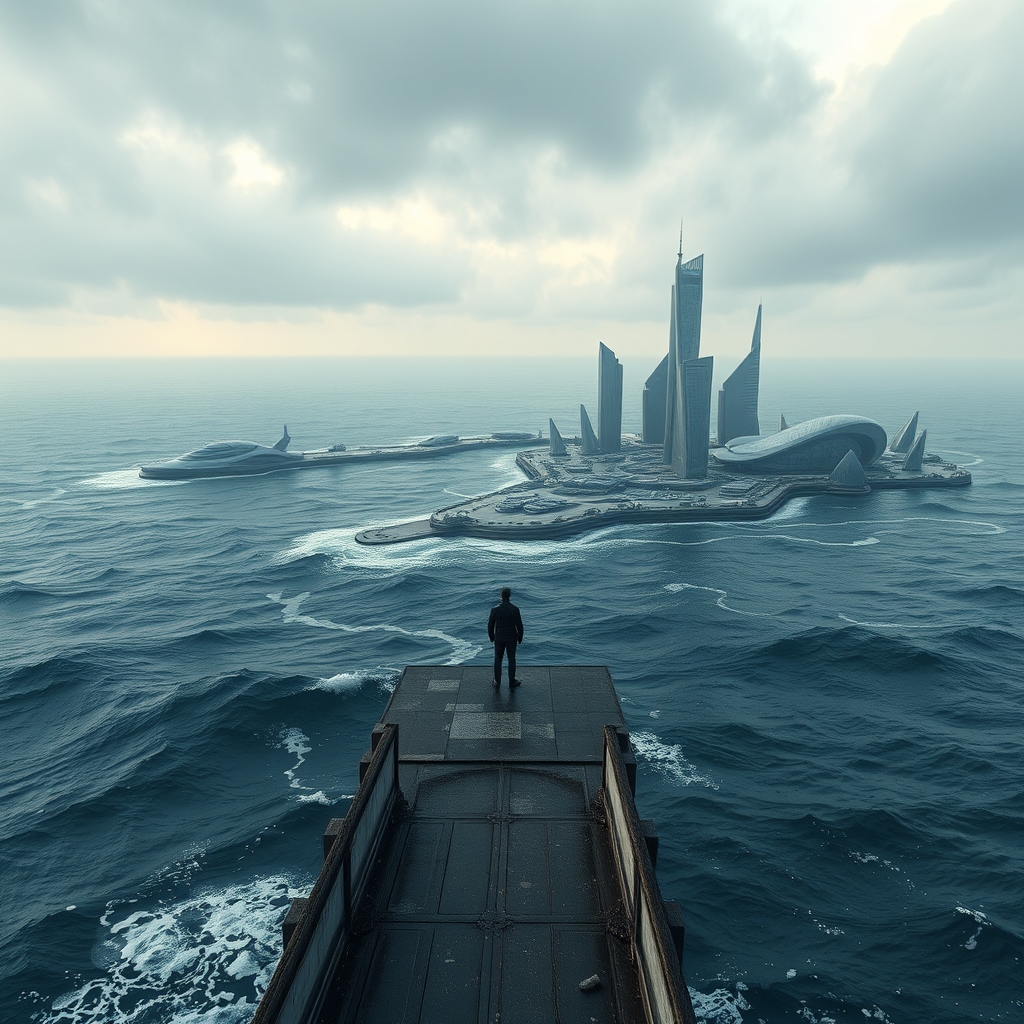
The ocean does not negotiate. It does not sign treaties, nor does it respect the meticulously rendered blueprints of engineers and urban planners. Yet, in the relentless pursuit of expansion, humanity has turned to the sea as if it were a blank canvas—one that can be reshaped, reclaimed, and repurposed at will. The rise of smart marine cities, artificial archipelagos, and floating real estate is often hailed as a triumph of innovation, a testament to human ingenuity in the face of land scarcity and climate uncertainty. But beneath the glossy renderings and sustainability buzzwords lies a fundamental miscalculation: the assumption that water can be outsmarted, contained, or bent to the will of human ambition without consequence.
The Myth of Control in Coastal Engineering
Coastal engineering has long operated under the illusion that the sea is a static adversary, one that can be tamed with enough concrete, steel, and computational modeling. The reality, however, is far more fluid. The ocean is a dynamic system, governed by forces that operate on timescales beyond human comprehension—tides that shift with lunar cycles, currents that defy prediction, and storms that rewrite coastlines in a matter of hours. Smart marine cities, with their sensor-laden infrastructures and AI-driven resilience strategies, promise to mitigate these risks. But resilience is not invincibility. The very term “coastal resilience” implies an ongoing struggle, a perpetual game of catch-up where the rules are dictated by nature, not by algorithms.
Consider the case of the Palm Jumeirah in Dubai, an artificial archipelago that has become the poster child for man-made island projects. Its iconic palm-shaped design was engineered to withstand the Arabian Gulf’s conditions, yet it has faced persistent erosion, subsidence, and the relentless encroachment of the sea. The solution? More dredging, more breakwaters, more intervention. This is not resilience; it is a hydrological arms race, one where the ocean always holds the upper hand. The Palm Jumeirah is not a triumph of engineering but a cautionary tale—a reminder that the sea does not yield, it adapts.
The Seductive Allure of Floating Real Estate
Floating real estate has emerged as the latest frontier in maritime urbanism, marketed as a sustainable alternative to traditional land reclamation. The logic is seductive: why fight the sea when you can float upon it? Projects like Oceanix City, a proposed network of modular floating platforms, promise self-sustaining, climate-resilient communities that rise and fall with the tides. But the reality is far more complex. Floating structures are not immune to the ocean’s whims. They must contend with corrosion, biofouling, and the sheer mechanical stress of constant motion. Moreover, they introduce a new layer of ecological disruption, altering marine habitats and sediment flows in ways that are not yet fully understood.
The allure of floating real estate lies in its perceived flexibility—its ability to adapt to rising sea levels without the need for massive landfill operations. Yet, this flexibility comes at a cost. Floating cities are inherently transient, tethered to the sea floor by mooring systems that are vulnerable to storms and seismic activity. They are not permanent solutions but temporary fixes, a Band-Aid on the wound of coastal vulnerability. The question is not whether floating cities can be built, but whether they should be—whether their existence perpetuates the illusion that the ocean can be colonized without consequence.
The Legal Quagmire of Submerged Land Rights
As humanity pushes further into the marine frontier, it collides with a legal landscape that is as murky as the waters it seeks to claim. Submerged land rights are a legal labyrinth, governed by a patchwork of international treaties, national laws, and maritime conventions that often conflict with one another. The United Nations Convention on the Law of the Sea (UNCLOS) establishes a framework for maritime boundaries, but it was not designed with artificial archipelagos or floating cities in mind. Who owns the seabed beneath a man-made island? Who is responsible when a floating structure drifts into international waters? These are not hypothetical questions—they are legal time bombs waiting to detonate.
The case of the Spratly Islands in the South China Sea illustrates the geopolitical tensions that arise when nations stake claims to artificial landmasses. China’s construction of military installations on reclaimed reefs has sparked disputes with neighboring countries, each asserting their own rights to the submerged territory. These conflicts are not just about sovereignty; they are about the very notion of what constitutes land in an era where the boundaries between sea and shore are increasingly blurred. The legal framework for submerged land rights is lagging behind the pace of technological innovation, leaving a void that is being filled by power struggles rather than principled governance.
The Ecological Gamble of Deep Sea Foundations
Deep sea foundations are the unsung heroes of maritime urbanism, the invisible structures that anchor artificial islands and floating cities to the ocean floor. But their ecological impact is far from invisible. The process of installing these foundations—whether through piling, dredging, or the use of gravity-based structures—disrupts marine ecosystems in profound ways. Sediment plumes smother benthic habitats, noise pollution disorients marine life, and the physical presence of these structures alters local hydrodynamics, creating artificial reefs that attract invasive species.
The irony is that many of these projects are marketed as eco-friendly, touting their use of renewable energy, sustainable materials, and low-impact designs. But sustainability in the marine context cannot be measured solely by carbon footprints or energy efficiency. It must account for the broader ecological footprint—the disruption of marine food chains, the loss of biodiversity, and the long-term consequences of altering natural sediment flows. The deep sea is not a wasteland; it is a complex, interconnected system that humanity is only beginning to understand. To treat it as a construction site is to gamble with the very foundations of marine life.
The Illusion of Sustainability in the Blue Economy
The blue economy—an economic model that seeks to harness the ocean’s resources in a sustainable manner—has become a rallying cry for proponents of maritime urbanism. It promises a future where coastal cities thrive without depleting the ocean’s resources, where land reclamation and floating real estate coexist with marine conservation. But the blue economy is not a panacea; it is a balancing act, one that is easily tipped by greed, short-term thinking, and the relentless pursuit of profit.
Luxury island resorts, for example, are often held up as exemplars of sustainable tourism, yet their ecological footprint tells a different story. The Maldives, a nation built on the promise of paradise, is now grappling with the consequences of decades of unchecked development. Coral reefs, the backbone of the Maldives’ marine ecosystems, are dying at an alarming rate due to sedimentation, pollution, and the physical damage caused by construction. The resorts that once promised an escape into nature are now contributing to its destruction, all while marketing themselves as eco-friendly havens. The blue economy’s sustainability narrative is, in many cases, a carefully crafted illusion—one that prioritizes economic growth over ecological integrity.
The ocean’s rules are not written in stone, but they are written in currents, tides, and the immutable laws of physics. Smart marine cities, artificial archipelagos, and floating real estate are not the future of coastal living; they are experiments in defiance, attempts to bend the ocean to human will. But the sea does not negotiate. It does not care for our blueprints, our legal frameworks, or our sustainability certifications. It responds to our interventions with indifference, with erosion, with storms that wash away our illusions of control. The question is not whether we can build these cities, but whether we should—whether we are prepared to accept the consequences of playing a game where the house always wins.