The Blue Illusion: How Eco-Friendly Reclamation Masks the True Costs of Maritime Urbanism
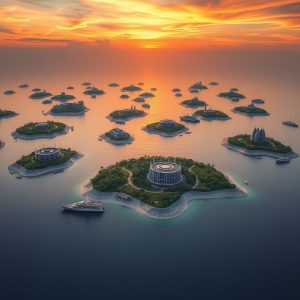
The ocean has long been humanity’s final frontier—a vast, untamed expanse that promises both opportunity and oblivion. In the race to expand urban footprints beyond the shoreline, the allure of man-made islands, floating cities, and artificial archipelagos has become irresistible. Proponents of these projects tout them as marvels of modern engineering, beacons of sustainability, and the future of coastal resilience. Yet beneath the glossy renderings and eco-friendly branding lies a more complicated truth: the blue economy’s infrastructure is not as sustainable as it claims, nor as resilient as it pretends to be.
The Myth of Eco-Friendly Reclamation
The term “eco-friendly reclamation” has become a buzzword in maritime urban planning, a salve for the conscience of developers and policymakers alike. Projects like the Maldives’ Hulhumalé or the Netherlands’ Marker Wadden are often cited as paragons of sustainable land augmentation, where dredged sediment is repurposed to create new land while minimizing ecological disruption. But the reality is far less pristine. The process of dredging itself disrupts marine ecosystems, smothering benthic habitats and altering sediment flows that have existed for millennia. The very act of reclaiming land from the sea is an exercise in controlled destruction, one that prioritizes human ambition over the delicate balance of coastal ecosystems.
Even when reclamation projects incorporate green design—such as artificial reefs, mangrove restoration, or permeable shorelines—they remain fundamentally extractive. The materials used to construct these islands, whether sand, rock, or concrete, must be sourced from somewhere, often at great environmental cost. The sand mining industry, for instance, has devastated riverbeds and coastal zones worldwide, leading to erosion, habitat loss, and even the disappearance of entire islands. The irony is stark: the creation of new land in one location often accelerates the destruction of existing land elsewhere.
The Fragility of Floating Real Estate
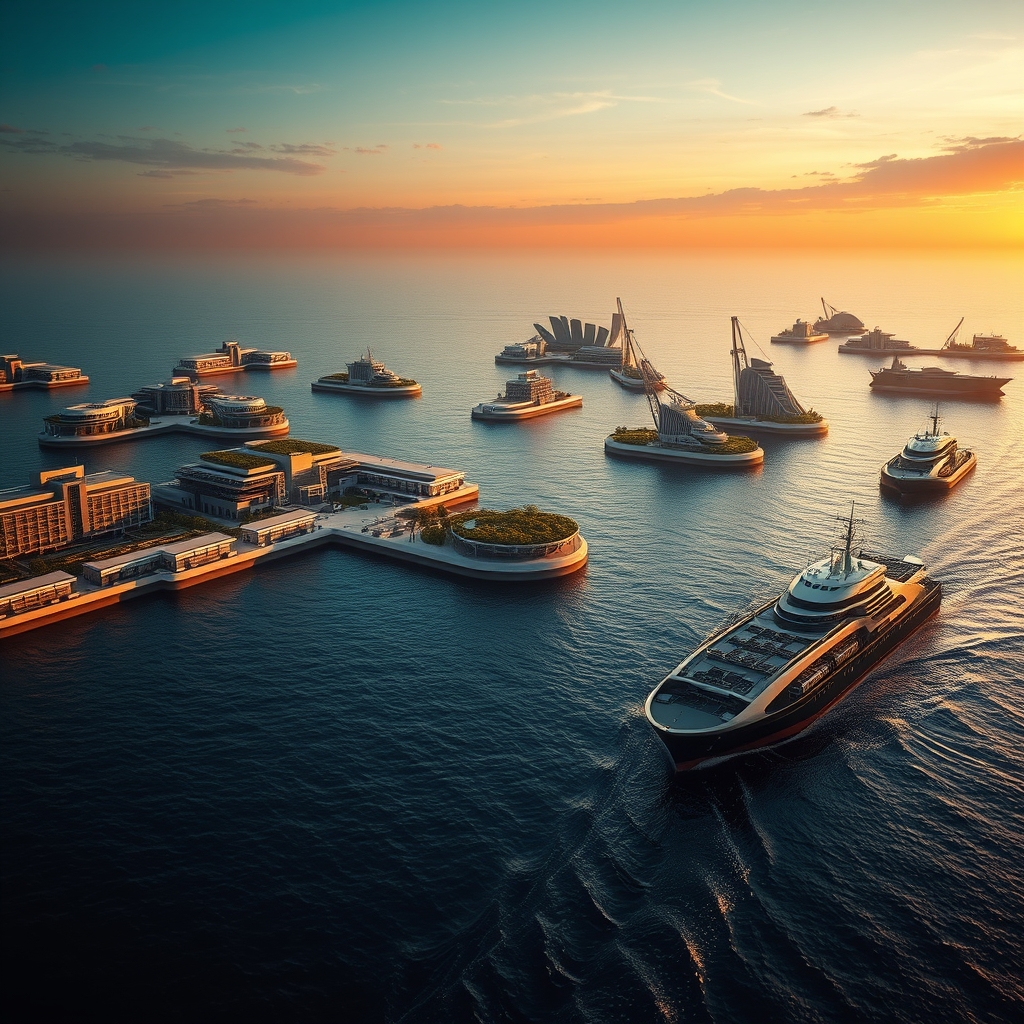
Floating real estate has emerged as a seemingly elegant solution to the challenges of sea-level rise and urban density. Projects like Oceanix City, a proposed floating metropolis designed to withstand hurricanes and rising tides, are marketed as the epitome of climate-adaptive urbanism. Yet these developments are not without their own set of vulnerabilities. The deep-sea foundations required to anchor floating structures are engineering feats that demand immense resources, both financial and material. The carbon footprint of constructing and maintaining these platforms is often overlooked in favor of their sleek, futuristic aesthetics.
Moreover, the legal and ethical implications of floating cities remain murky. Who owns the water beneath these structures? How do submerged land rights apply when the land in question is not fixed but fluid? The blue economy’s expansion into floating real estate raises questions about sovereignty, jurisdiction, and the commodification of the ocean itself. As these projects proliferate, they risk creating a new form of maritime gentrification, where only the wealthy can afford to live on the water, while the ecological costs are borne by all.
The Illusion of Coastal Resilience
Coastal resilience is often framed as the ultimate goal of maritime urbanism, a way to future-proof cities against the inevitable impacts of climate change. Yet the resilience promised by man-made islands and artificial archipelagos is, at best, a temporary fix. These projects are designed to withstand specific threats—storm surges, rising sea levels, erosion—but they are not immune to the broader, more unpredictable forces of nature. The ocean is not a static canvas; it is a dynamic, living system that adapts and responds to human intervention in ways that are often unforeseen.
Consider the case of Dubai’s Palm Jumeirah, one of the most famous artificial archipelagos in the world. While it has become a symbol of luxury and innovation, it has also faced significant challenges, from erosion to subsidence. The islands were designed to mimic natural landforms, but their rigid, engineered structures lack the flexibility of organic coastlines. As sea levels rise and storms intensify, the Palm Jumeirah—and projects like it—may find themselves locked in a perpetual battle against the very forces they were meant to conquer.
The Ethical Dilemma of Land Augmentation
The ethical implications of land augmentation extend beyond environmental concerns. The creation of new land in the ocean raises profound questions about equity, access, and the right to the sea. Who benefits from these projects, and who bears the costs? In many cases, man-made islands and floating cities are designed for the elite, offering luxury resorts, high-end real estate, and exclusive amenities. Meanwhile, the communities most vulnerable to climate change—those living in low-lying coastal areas—are often displaced or left to contend with the environmental fallout of these developments.
There is also the question of cultural heritage. Coastal communities have long relied on the ocean for sustenance, identity, and livelihood. The transformation of the shoreline into a playground for the wealthy risks erasing the deep, historical connections between people and the sea. The blue economy’s infrastructure, with its focus on profit and innovation, often overlooks the intangible value of the ocean as a shared resource, a source of cultural memory, and a vital ecosystem.
The Future of Maritime Urbanism: A Reckoning
The allure of man-made islands and floating cities is undeniable. They represent a bold vision of the future, one where humanity’s ingenuity allows us to expand beyond the constraints of the natural world. Yet this vision is not without its flaws. The blue economy’s infrastructure, for all its promise, remains a work in progress—one that must grapple with the environmental, ethical, and practical challenges of building on water. The question is not whether we can create these structures, but whether we should, and at what cost.
The ocean is not a blank slate, nor is it an infinite resource. It is a finite, fragile ecosystem that demands respect and restraint. As we continue to push the boundaries of maritime urbanism, we must confront the uncomfortable truth that our ambitions may outpace our ability to mitigate their consequences. The future of coastal resilience lies not in the illusion of control, but in the humility to recognize that the sea will always have the final say.