The Invisible Tides: How Waterfront Urbanism is Drowning in Its Own Ambition
The relentless march of waterfront urbanism is not merely a testament to human ingenuity but a stark illustration of its hubris. As cities sprawl toward the sea, the allure of limitless expansion collides with the immutable laws of nature, revealing a paradox: the more we reclaim, the more we risk losing. This is not a cautionary tale of failure but a critical examination of how ambition, when unchecked by ecological foresight, becomes its own undoing.
The Illusion of Control in Coastal Engineering
Coastal engineering has long operated under the assumption that nature can be bent to human will. Breakwaters, seawalls, and landfill projects are engineered with precision, yet they remain at the mercy of forces far greater than steel and concrete. The Netherlands, often hailed as the gold standard of reclamation, spends billions annually to hold back the North Sea. But even their vaunted Delta Works—a marvel of modern engineering—is a temporary fix, a Band-Aid on a wound that deepens with every centimeter of sea-level rise. The question is not whether these structures will fail, but when.
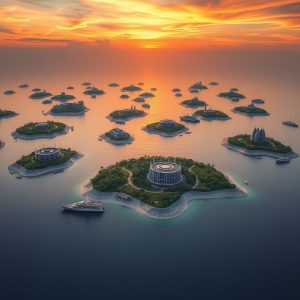
Artificial archipelagos, once the stuff of science fiction, now dot coastlines from Dubai to China. The Palm Jumeirah, a man-made island shaped like a palm tree, is a monument to excess, its luxury resorts and villas perched precariously on reclaimed sand. Yet beneath its glittering surface lies a fragile ecosystem teetering on collapse. Erosion gnaws at its edges, and the dredging required to maintain it disrupts marine habitats, turning vibrant coral reefs into lifeless deserts. The irony is palpable: the very projects designed to showcase human dominance over nature are accelerating its decline.
The Myth of Sustainable Reclamation
The term “eco-friendly reclamation” has become a buzzword, a salve for the conscience of developers and policymakers alike. But sustainability in this context is a relative term, often measured by the least harmful option rather than a truly regenerative one. Projects like Singapore’s Marina Bay Sands or Hong Kong’s Lantau Tomorrow Vision are touted as models of green urbanism, yet their environmental impact is far from neutral. The carbon footprint of dredging, the disruption of sediment flows, and the loss of biodiversity are externalities conveniently overlooked in the pursuit of progress.
Floating real estate, another darling of the blue economy, promises a solution to rising sea levels. Cities like Amsterdam and Maldives are experimenting with amphibious architecture, buildings that rise and fall with the tides. But these innovations are not scalable. They cater to the wealthy, offering a lifeboat for the elite while leaving the rest to grapple with the consequences of a warming planet. The blue economy, with its rhetoric of sustainability, is little more than a rebranding of exploitation, where the ocean’s resources are mined for profit under the guise of innovation.
The Legal Quagmire of Submerged Land Rights
As nations race to stake their claim on the seabed, the legal framework governing submerged land rights remains a labyrinth of ambiguity. The United Nations Convention on the Law of the Sea (UNCLOS) was designed to prevent conflicts, yet it has become a tool for nations to assert dominance. China’s Nine-Dash Line, a demarcation that claims nearly the entire South China Sea, is a blatant disregard for international law, yet it persists because the cost of enforcement outweighs the will to challenge it. Meanwhile, smaller nations, like those in the Pacific, watch helplessly as their maritime borders are eroded by rising seas and the encroachment of foreign powers.
The legal battles over submerged land are not just about territory; they are about the future of the blue economy. Who owns the rights to the minerals beneath the ocean floor? Who is responsible for the environmental damage caused by deep-sea mining? These questions remain unanswered, leaving a vacuum that corporations and nations are all too eager to fill. The result is a free-for-all, where the ocean’s resources are up for grabs, and the losers are the ecosystems and communities that depend on them.
The Cost of Coastal Resilience
Coastal resilience is often framed as a technical challenge, a problem to be solved with better engineering and smarter urban planning. But resilience is not just about withstanding storms; it is about adapting to a new reality where the sea is no longer a passive backdrop but an active participant in the fate of cities. The Netherlands’ Room for the River program, which allows floodplains to expand during high water, is a rare example of humility in the face of nature. Yet such approaches are the exception, not the rule.
Most coastal cities are doubling down on the same strategies that got them into trouble in the first place. Miami, a city built on porous limestone, pumps out seawater like a sinking ship bailing water, yet its leaders continue to approve high-rise developments in flood zones. New Orleans, still recovering from Hurricane Katrina, clings to its levees, even as scientists warn that they are no match for the next big storm. The cost of resilience is not just financial; it is psychological. It requires admitting that the sea, not the city, has the final say.
The Future of Maritime Urbanism: A Choice Between Collapse and Adaptation
The future of waterfront urbanism hinges on a simple but uncomfortable truth: the sea is not a frontier to be conquered but a partner to be respected. Smart marine cities, with their sensors and data-driven decision-making, offer a glimmer of hope. But technology alone cannot save us. What is needed is a fundamental shift in how we conceive of coastal development—one that prioritizes ecological integrity over economic growth, and long-term survival over short-term gain.
Some cities are beginning to embrace this shift. Copenhagen’s Cloudburst Management Plan, which integrates green infrastructure to absorb stormwater, is a step in the right direction. Rotterdam’s floating pavilions and water plazas reimagine urban space as something fluid, not fixed. These are not perfect solutions, but they acknowledge a reality that most cities still refuse to face: the sea is rising, and we must rise with it—or be swallowed by it.
The allure of waterfront urbanism is undeniable. The promise of new land, new wealth, and new possibilities has driven human ambition for centuries. But ambition without restraint is a recipe for disaster. The cities that thrive in the coming decades will not be those that fight the sea, but those that learn to live with it. The invisible tides of change are already upon us, and the choice is clear: adapt or drown.