The Liquid Paradox: How Floating Real Estate is Rewriting the Rules of Coastal Sovereignty
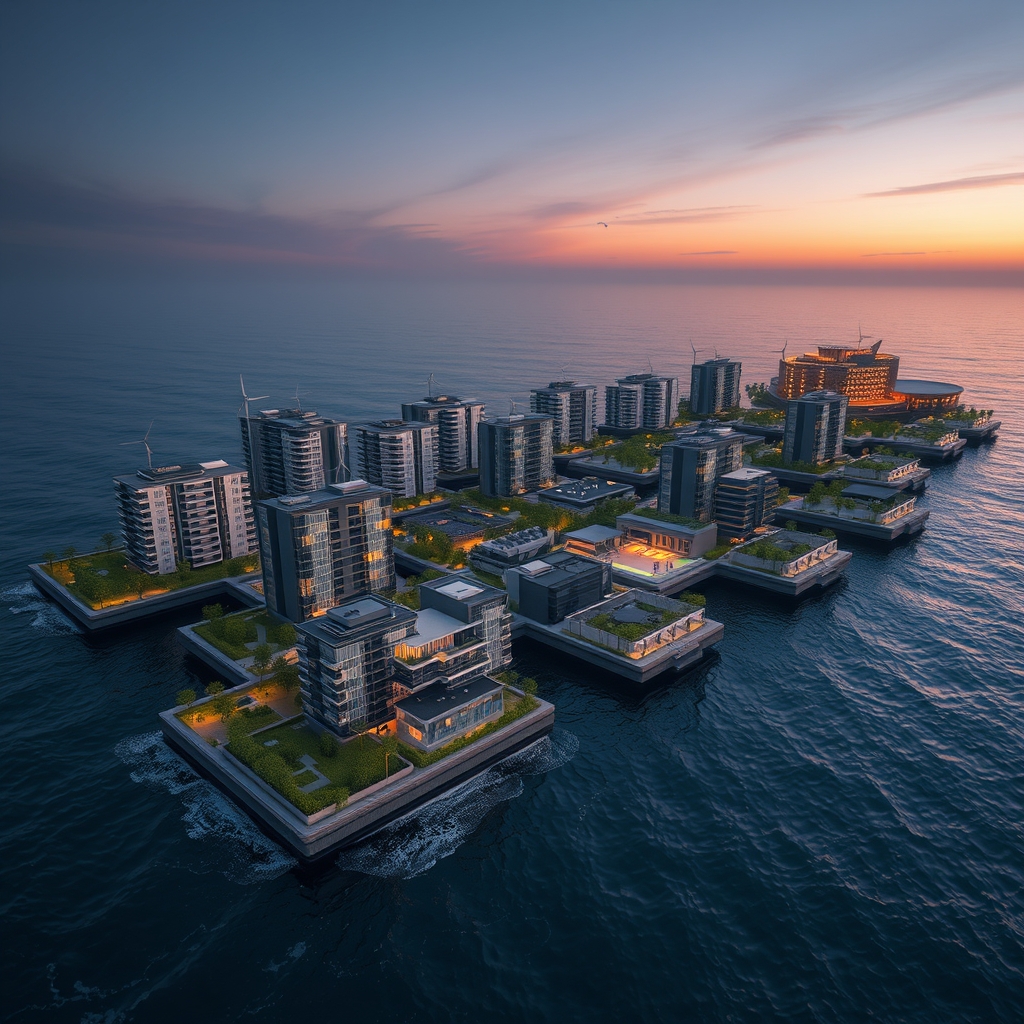
The ocean has always been a frontier of human ambition, but never before has it been so systematically colonized as it is today. Floating real estate—once a niche experiment in maritime engineering—has evolved into a full-fledged industry, reshaping the boundaries of urban expansion, coastal resilience, and even national sovereignty. What was once dismissed as a futuristic fantasy is now a tangible, if contentious, reality: entire neighborhoods, luxury resorts, and even government buildings rising from the waves, defying the traditional constraints of land and sea.
The Illusion of Permanence in a Fluid World
At first glance, floating developments appear to solve a fundamental problem: the scarcity of habitable land in an era of rapid urbanization and rising sea levels. Cities like Amsterdam and Malé have long grappled with spatial limitations, but floating architecture offers a seemingly elegant solution—expand outward, not upward. Yet, the permanence of these structures is an illusion. Unlike traditional land reclamation, which relies on dredging and sediment to create new terrestrial ground, floating real estate exists in a state of perpetual negotiation with the ocean’s whims. Tides, storms, and corrosion are not obstacles to overcome but conditions to endure, demanding constant adaptation rather than conquest.
The Dutch, pioneers in both land reclamation and floating urbanism, have demonstrated that resilience is not about defying nature but coexisting with it. Their floating neighborhoods, such as Schoonschip in Amsterdam, are not static fortresses but dynamic systems, designed to rise and fall with the water. This approach challenges the conventional wisdom of coastal engineering, which has historically sought to impose rigid structures upon a fluid environment. The question, then, is whether floating real estate represents a paradigm shift or merely a temporary workaround in humanity’s relentless pursuit of dominion over the sea.
The Geopolitical Ripple Effect
Beyond the technical challenges, floating real estate introduces a thorny geopolitical dilemma: sovereignty. When a structure is not anchored to the seabed but floats freely, does it belong to the nation whose waters it occupies? Or does it become a de facto independent entity, subject to its own rules and regulations? The United Nations Convention on the Law of the Sea (UNCLOS) provides a framework for submerged land rights, but floating developments occupy a legal gray area. They are neither fully terrestrial nor entirely maritime, existing in a liminal space that defies traditional categorization.
This ambiguity has not gone unnoticed by nations and corporations alike. In the South China Sea, where artificial islands have already sparked territorial disputes, floating cities could further complicate an already volatile situation. If a private developer constructs a self-sustaining floating community, complete with its own governance and economy, does it owe allegiance to any nation? The potential for tax havens, autonomous zones, and even micronations is not far-fetched. Floating real estate could become the next frontier in the erosion of state control, a liquid Wild West where the rules of land-based governance no longer apply.
The Economic Mirage of Floating Luxury
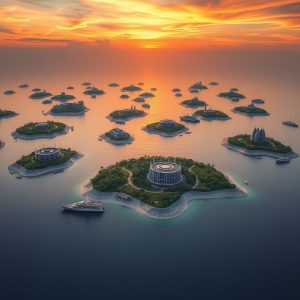
For all its promise, floating real estate remains an overwhelmingly luxury-driven enterprise. The most high-profile projects—such as Oceanix City, a proposed floating metropolis designed by BIG (Bjarke Ingels Group), or the Maldives’ Amillarah Private Islands—cater to the ultra-wealthy, offering exclusivity and novelty at a premium. This raises ethical questions about equity and access. If floating developments are positioned as solutions to climate change and urban overcrowding, why are they predominantly accessible only to those who can afford million-dollar villas?
The blue economy, often touted as a sustainable alternative to terrestrial exploitation, risks becoming another playground for the elite. Floating resorts and private islands may generate revenue, but they do little to address the broader challenges of coastal resilience and equitable urban expansion. The danger is that floating real estate becomes a symbol of escapism rather than innovation—a way for the wealthy to retreat from the consequences of climate change rather than confront them.
The Environmental Cost of Liquid Utopias
Proponents of floating real estate argue that it is inherently more sustainable than traditional land reclamation. After all, it does not require the dredging of seabeds or the displacement of marine ecosystems. Yet, this narrative overlooks the environmental trade-offs. Floating structures still disrupt local currents, alter sedimentation patterns, and introduce foreign materials into marine environments. The energy required to maintain these developments—whether through desalination plants, waste management systems, or climate control—often relies on fossil fuels, undermining their green credentials.
Moreover, the long-term ecological impact of large-scale floating developments remains poorly understood. Coral reefs, seagrass beds, and other critical marine habitats could be smothered or displaced by the sheer scale of these projects. The ocean is not an infinite resource, and floating real estate, like all forms of coastal development, carries an ecological footprint that extends far beyond the visible structure.
The Future of Floating Sovereignty
As climate change accelerates and coastal cities face existential threats, floating real estate will likely become an increasingly attractive option. But its success—or failure—will depend on whether it can transcend its current limitations. Can floating developments be scaled to accommodate more than just the wealthy? Can they be integrated into existing urban frameworks without exacerbating inequality? And can they truly coexist with marine ecosystems, or will they simply replicate the extractive logic of terrestrial development?
The answers to these questions will determine whether floating real estate remains a niche luxury or evolves into a viable model for sustainable urban expansion. The ocean has always been a realm of both opportunity and peril, and floating cities embody this duality. They offer a tantalizing glimpse of a future where humanity and the sea exist in harmony, but they also risk becoming another chapter in the long history of human hubris. The liquid frontier is not just a physical space; it is a test of our ability to adapt, innovate, and, above all, respect the forces that have shaped our planet for millennia.