The Shifting Sands of Progress: How Sustainable Land Reclamation is Redefining Coastal Identity
The relentless march of urban expansion has pushed coastal cities to the brink of their natural boundaries, forcing a reckoning with the limits of terrestrial space. In response, land augmentation has emerged as a seductive solution—a way to conjure new real estate from the sea itself. Yet, the narrative of progress embedded in these projects is far from straightforward. Sustainable land reclamation is not merely an engineering feat; it is a cultural and ecological recalibration, one that demands a critical examination of what it means to reshape the coastline in an era of climate uncertainty.
The Illusion of Control in Coastal Engineering
Coastal engineering has long operated under the assumption that human ingenuity can outpace natural forces. From the Netherlands’ centuries-old polders to Dubai’s Palm Islands, the history of land reclamation is littered with examples of ambition clashing with ecological reality. The modern iteration of this practice—sustainable land reclamation—promises a more harmonious relationship with the marine environment. But the term “sustainable” is often wielded as a shield against scrutiny, obscuring the fact that even the most eco-friendly reclamation projects carry hidden costs.
Take, for instance, the use of dredged sediment to create new land. While this method avoids the environmental pitfalls of traditional concrete and rock infill, it disrupts benthic ecosystems and alters sediment transport patterns, with cascading effects on marine biodiversity. The deep sea foundations required to stabilize these artificial landmasses further complicate the equation, as they introduce foreign structures into delicate underwater habitats. The question is not whether these projects can be done, but whether they should be—especially when the long-term consequences remain poorly understood.
The Paradox of Waterfront Urbanism
Waterfront urbanism has become a hallmark of contemporary city planning, with reclaimed land serving as the canvas for luxury resorts, high-end residential complexes, and smart marine cities. These developments are marketed as the epitome of coastal resilience, designed to withstand rising sea levels and extreme weather events. Yet, their very existence is predicated on a paradox: the more we fortify the coastline, the more we disrupt the natural processes that have historically protected it.
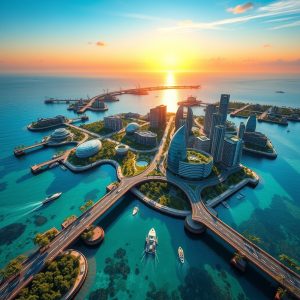
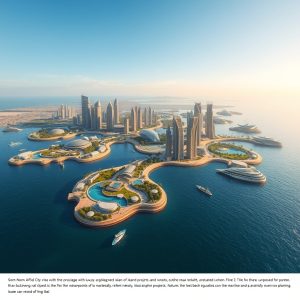
Consider the case of artificial archipelagos, which are often touted as a solution to urban sprawl. By distributing development across multiple islands, planners argue that they can reduce pressure on existing coastal infrastructure. However, these projects frequently prioritize aesthetic and economic value over ecological integrity. The result is a fragmented landscape where natural shorelines are replaced by rigid, engineered edges, eroding the dynamic interplay between land and sea that has sustained coastal ecosystems for millennia.
The Legal and Ethical Labyrinth of Submerged Land Rights
Reclamation projects do not exist in a legal vacuum. The creation of new land from the sea raises thorny questions about ownership, jurisdiction, and environmental responsibility. Submerged land rights, once a niche area of maritime law, have become a battleground for nations, corporations, and environmental advocates. Who owns the seabed? Who is liable for the ecological damage caused by dredging and construction? And how do we reconcile the economic benefits of reclamation with the rights of future generations to a healthy marine environment?
These questions are particularly pressing in regions where the blue economy infrastructure is expanding rapidly. In Southeast Asia, for example, competing claims over reclaimed land have sparked geopolitical tensions, while in the Caribbean, luxury island resorts have been accused of exploiting local communities and ecosystems. The legal frameworks governing these projects are often outdated, ill-equipped to address the complexities of modern land augmentation. Without robust regulations, the risk of exploitation—both environmental and social—remains alarmingly high.
The Future of Coastal Resilience: Beyond Engineering
If sustainable land reclamation is to live up to its name, it must move beyond the narrow confines of engineering and embrace a more holistic approach. This means integrating ecological restoration into the design process, prioritizing the preservation of natural shorelines, and adopting adaptive strategies that allow coastal systems to evolve alongside human development. Smart marine cities, for instance, could leverage floating real estate and modular infrastructure to minimize their footprint, while artificial archipelagos could be designed to mimic natural island formations, fostering biodiversity rather than stifling it.
Yet, even the most innovative solutions will falter without a fundamental shift in how we perceive the coastline. The sea is not a blank canvas to be molded at will; it is a dynamic, living system that demands respect. The challenge of coastal resilience is not merely technical but philosophical, requiring us to rethink our relationship with the marine environment. As sea levels rise and storms grow more intense, the question is no longer whether we can reclaim the coast, but whether we can do so without losing what makes it worth reclaiming in the first place.
The allure of land augmentation is undeniable, offering a tantalizing glimpse of a future where urban expansion knows no bounds. But the true measure of progress lies not in the square meters of new land we create, but in our ability to coexist with the forces that have shaped the coastline for centuries. The shifting sands of progress demand more than engineering prowess—they require wisdom, restraint, and a willingness to confront the limits of our own ambition.