The Architectural Mirage: How Artificial Archipelagos Are Exploiting the Illusion of Infinite Space

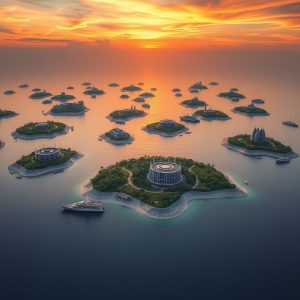
In the grand theater of coastal development, artificial archipelagos stand as a testament to human ambition, promising new lands where the sea once ruled. These man-made islands, crafted from sand and sediment, are a stark contrast to the natural rhythms of the ocean. They represent a bold experiment in urban expansion, a gamble that the human touch can tame the sea’s fury.
The Illusion of Permanence
Artificial archipelagos are built on the fragile foundation of time. The sand and sediment used to create these islands are not permanent. They are subject to the relentless forces of erosion, storms, and rising sea levels. Yet, the allure of permanence is strong, and developers often market these islands as eternal havens. This is an illusion, a seductive promise that masks the true nature of these creations.
The Ethical Tightrope
Walking the tightrope of ethics, artificial archipelagos raise questions about the balance between ambition and ecology. On one side, they offer new spaces for human habitation, economic growth, and leisure. On the other, they threaten fragile ecosystems, disrupt marine life, and alter the natural balance of the coast. The ethical dilemma is clear: can human ambition coexist with the ocean’s power?
The Geopolitical Undertow
Beyond the ethical considerations, artificial archipelagos are reshaping geopolitical landscapes. They are becoming strategic assets, military outposts, or economic hubs. The lines of sovereignty are being redrawn, and the stakes are high. These islands are not just about land; they are about power, influence, and control.
The Unseen Depths
Deep sea foundations, the hidden giants of artificial archipelagos, are a testament to human ingenuity. They are the silent sentinels that hold these islands in place. However, they also represent a new frontier in coastal engineering, a realm where the boundaries between land and sea are being redrawn. The unseen depths of these foundations are a reminder that the ocean’s power is not to be underestimated.
Artificial archipelagos are a microcosm of the broader struggle between human ambition and the ocean’s power. They are a testament to our ability to reshape the coast, but also a warning about the limits of our control. In the grand theater of coastal development, the illusion of infinite space is a dangerous one, a seductive promise that masks the true nature of these creations.