The Future of Work: How Smart Buildings and Sustainable Architecture are Reshaping Real Estate
The modern professional landscape is undergoing a metamorphosis that extends far beyond the mere digitization of daily tasks. As the boundaries between professional and personal life blur, the physical spaces we occupy are being fundamentally reimagined. The traditional, static office building is rapidly becoming a relic of the past, making way for environments that actively participate in the well-being of their occupants and the health of the planet. This evolution is driven by a powerful confluence of environmental urgency, technological advancement, and a profound shift in human priorities.
At the heart of this transformation is the realization that our built environment must be as dynamic as the workforce it houses. We are moving away from rigid structures toward fluid, responsive ecosystems. By embracing innovative design philosophies and cutting-edge technologies, developers and architects are crafting spaces that not only minimize environmental impact but actively enhance human potential.
Pioneering the Net Zero Frontier
The push toward a sustainable future has placed Net Zero Offices at the forefront of commercial real estate development. These pioneering structures represent a commitment to producing as much energy as they consume, effectively neutralizing their carbon footprint. Achieving this ambitious goal begins from the ground up, heavily relying on Carbon Neutral Construction practices. Builders are increasingly turning to Green Building Materials—such as cross-laminated timber, recycled steel, and low-carbon concrete—to significantly reduce embodied carbon before the doors even open.
Beyond the structural components, the exterior of these buildings plays a crucial role. High Performance Facades are being engineered to act as intelligent skins, dynamically adjusting to environmental conditions. These advanced exteriors maximize natural light penetration while minimizing solar heat gain, drastically reducing the reliance on artificial lighting and energy-intensive climate control. When combined with on-site renewable energy generation, these architectural marvels set a new standard for ecological responsibility.
Cultivating Health and Human Flourishing
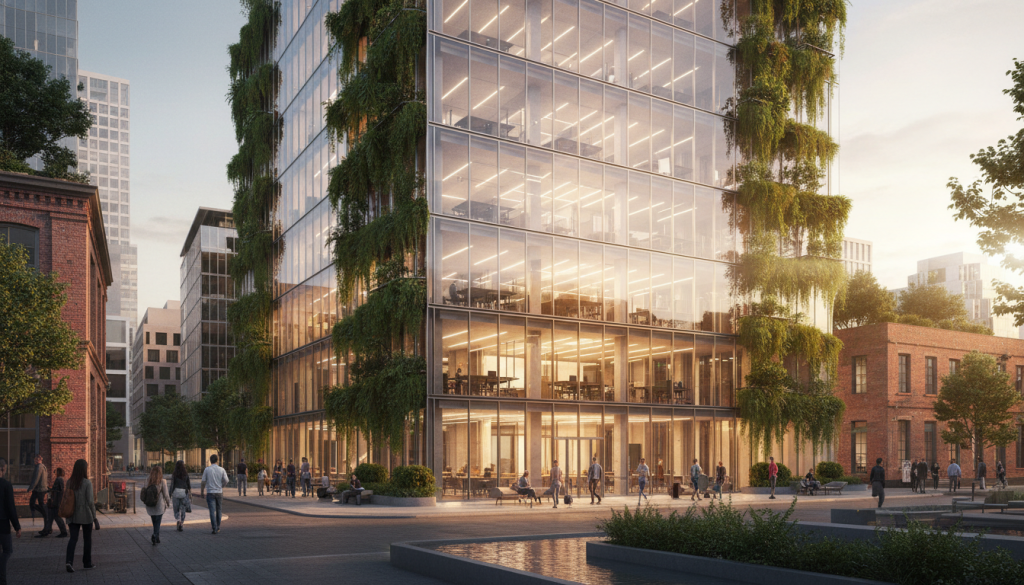
Sustainability is no longer measured solely by energy metrics; human health is now a paramount consideration. The emergence of the Biophilic Workspace is a testament to our innate need to connect with nature. Incorporating living walls, indoor water features, and expansive views of greenery, these designs go beyond mere aesthetics. They are scientifically proven to reduce stress, enhance cognitive function, and boost overall productivity.
This nature-centric approach is formalized through the pursuit of becoming Wellness Certified Buildings. By adhering to rigorous Healthy Building Standards, developers ensure that indoor environments actively promote physical and mental well-being. Central to this is the deployment of advanced Thermal Comfort Systems and superior air filtration technologies. These systems continuously monitor and adjust indoor climates, ensuring optimal humidity, temperature, and air purity, thereby creating an environment where occupants can truly thrive.
The Synergy of Technology and Flexibility
The physical evolution of the workspace is deeply intertwined with the digital revolution. Smart Buildings are no longer a futuristic concept but a present-day necessity. Through seamless PropTech Integration, these structures are equipped with a central nervous system of sensors and software. Intelligent Building Management platforms analyze real-time data on occupancy, energy usage, and environmental conditions, automatically optimizing building operations to maximize efficiency and comfort.
This technological backbone is essential for supporting modern Hybrid Work Infrastructure. As companies adopt more fluid operational models, the demand for Flexible Coworking Spaces and Modular Office Design has skyrocketed. Spaces must be easily reconfigurable to accommodate collaborative workshops one day and focused, individual tasks the next. Furthermore, the rise of Decentralized Offices—where organizations maintain a network of smaller, strategically located hubs rather than a single massive headquarters—relies heavily on robust digital connectivity and smart space utilization.
Rethinking Urban Development
True sustainability involves making the most of what we already have. Adaptive Reuse has emerged as a powerful strategy, transforming obsolete warehouses, factories, and even retail centers into vibrant, modern workspaces. This approach not only preserves architectural heritage but also avoids the massive carbon expenditure associated with demolition and new construction. Through meticulous Energy Efficient Retrofitting, these historical structures are upgraded with modern insulation, smart HVAC systems, and energy-saving lighting, bringing them up to contemporary performance standards.
The integration of workspaces into broader urban ecosystems is also gaining momentum. Mixed Use Developments blend residential, commercial, and recreational spaces, creating walkable communities that reduce commute times and foster local economies. This holistic approach to urban planning ensures that commercial buildings are not isolated fortresses but integral, contributing components of a vibrant neighborhood.
The Financial Engine of Innovation
Funding these ambitious projects requires equally innovative financial mechanisms. Real Estate Tokenization is democratizing access to property investment, allowing individuals to purchase fractional ownership in cutting-edge, sustainable developments using blockchain technology. This influx of diverse capital is accelerating the adoption of green technologies and smart infrastructure, proving that ecological responsibility and economic viability can go hand in hand.
The spaces we inhabit shape the way we think, collaborate, and envision our future. As the concrete jungles of the past slowly give way to living, breathing ecosystems of innovation, the boundary between the natural world and the built environment continues to dissolve. Embracing this architectural evolution is not merely a strategy for corporate efficiency or a nod to environmental compliance; it is a profound commitment to human potential. By designing spaces that are as resilient and adaptable as the people within them, we lay the foundation for a more sustainable, interconnected, and harmonious world.