The Architecture of Efficiency: Deconstructing the Smart and Sustainable Real Estate Paradigm
The modern metropolis is undergoing a forced, albeit necessary, evolution. Driven simultaneously by stringent climate mandates and an insatiable market appetite for technological integration, developers are rapidly pivoting toward a new paradigm of urban construction. We are witnessing the aggressive financialization of connectivity and ecology, packaged neatly into high-yielding asset classes. The rhetoric surrounding this shift is predictably utopian, yet a clinical examination of current projects reveals a landscape where genuine architectural innovation frequently collides with superficial marketing.
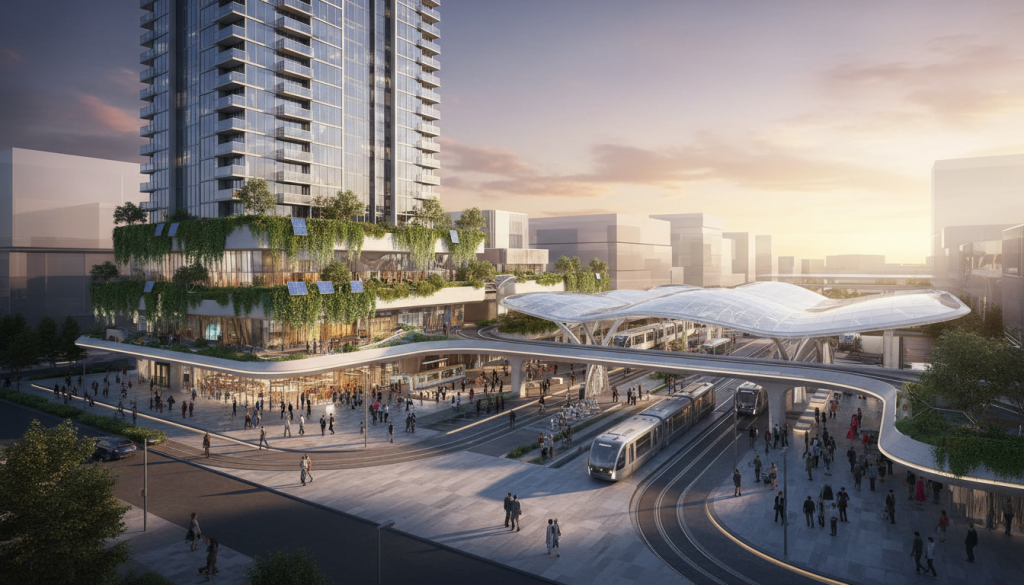
At the core of this urban restructuring is the concept of Smart City Real Estate. This is not merely the proliferation of fiber optics or municipal Wi-Fi; it represents a fundamental shift toward data-driven urban management. Institutional investors are pouring capital into zones where infrastructure communicates directly with the built environment. However, the true anchor of these smart ecosystems is Transit Oriented Development (TOD). By centralizing high-density, mixed-use developments around robust public transit hubs, city planners are attempting to engineer out the inefficiencies of urban sprawl. For the analytical investor, TODs represent one of the most resilient real estate investment opportunities available today. They capture a captive demographic, reduce municipal carbon footprints, and consistently demonstrate lower vacancy rates during economic downturns compared to isolated suburban housing trends.
The Illusion and Reality of Luxury Smart Homes
When the macro-level smart city filters down to the micro-level of individual dwellings, the narrative often fractures. The current iteration of Luxury Smart Homes is frequently plagued by a fundamental misunderstanding of what constitutes luxury. Developers routinely conflate excessive digitization with elevated living. A voice-activated lighting system or an internet-connected refrigerator does not signify architectural advancement; it signifies planned obsolescence. True luxury in the modern age is defined by frictionless integration and systemic autonomy.
The most compelling luxury penthouse suites and premium villa living spaces are those that leverage technology invisibly. They utilize predictive climate control algorithms that adjust to human circadian rhythms, dynamic glazing that responds to solar intensity to reduce HVAC loads, and integrated biometric security that operates without active user input. The critical distinction lies between features that demand continuous occupant management and systems that genuinely liberate the resident’s time. Properties that rely on the former are destined to age poorly, while those anchored in the latter command enduring market premiums and represent a superior class of prime residential land.
Sustainable Green Homes: Beyond the Certification
Parallel to the digitization of the home is the aggressive push toward Sustainable Green Homes and eco-friendly apartments. The market has rightly recognized that sustainability is no longer a fringe preference but a baseline requirement for institutional capital. Yet, the proliferation of “green” real estate necessitates a high degree of skepticism. Much of what is marketed as sustainable living is little more than architectural greenwashing—the strategic placement of a few solar panels or a living wall to secure a certification plaque.
A rigorous critique of these developments demands looking past the marketing brochures and into the structural energy modeling. Genuine sustainable green homes operate on the principles of passive design, thermal mass utilization, and closed-loop water systems. They do not merely consume less energy; they actively contribute to the grid. For investors evaluating commercial shophouse investments or industrial land development, the focus must shift from superficial green aesthetics to verifiable metrics of energy autonomy and lifecycle carbon analysis. Properties that fail to meet these stringent environmental standards will inevitably face steep “brown discounts” as regulatory frameworks tighten globally.
Redefining Urban Living Spaces
The synthesis of smart technology and sustainable design is fundamentally redefining urban living spaces. We are moving away from the isolated, single-use zoning of the past century toward hyper-integrated mixed-use developments. These modern hubs blend high-rise apartments, commercial office spaces, and modern shopping mall design into cohesive, walkable ecosystems. The economic rationale is unassailable: by compressing the distance between living, working, and consuming, developers create self-sustaining micro-economies that insulate themselves from broader macroeconomic volatility.
Yet, the success of these integrated developments hinges entirely on their execution. High-density living requires exceptional acoustic insulation, rigorous air quality management, and thoughtful spatial geometry to prevent the psychological fatigue often associated with urban environments. The developments that succeed will be those that prioritize human-centric design over maximum yield per square foot. They will recognize that the ultimate amenity is not a digital concierge, but the seamless orchestration of light, air, and space.
The trajectory of modern real estate is irrefutably bound to the dual pillars of ecological responsibility and technological integration. As the novelty of smart devices fades and the reality of climate economics solidifies, the market will mercilessly separate superficial developments from those possessing genuine architectural substance. Capital will increasingly flow toward assets that offer measurable efficiencies and resilient infrastructure, rather than those relying on digital gimmicks. The most lucrative investments of the coming decade will not be found in properties that loudly proclaim their innovation, but in those that quietly and flawlessly execute the complex demands of the modern urban condition.